
Korea Added $2.3 Trillion. Taiwan Bet It All on Chips. Why Did India's Stock Market Drop To 7th Place?

The markets that passed us didn't get lucky — they got reformed. The way back isn't a secret. It's a playbook we're refusing to copy.
In the first five months of 2026, South Korea added roughly $2.3 trillion to the value of its stock market — a gain larger than the entire market capitalisation of all but a handful of countries on earth. Taiwan, riding a single chipmaker, climbed to about $5 trillion. Both now sit above India, which has slipped to seventh in the global rankings at around $4.8 trillion.

We are being told not to worry. India being overtaken has been rationalised as a feature, not a bug: Taiwan is a concentrated market riding the AI wave through TSMC, while India is “very, very diversified.” It is a comforting explanation. It is also exactly the wrong lesson.
Because the real story across Asia this year is not that a few chip stocks went up. It is that governments decided to rebuild the plumbing of their capital markets — and the money followed.
The scoreboard is humiliating — and it isn't close.
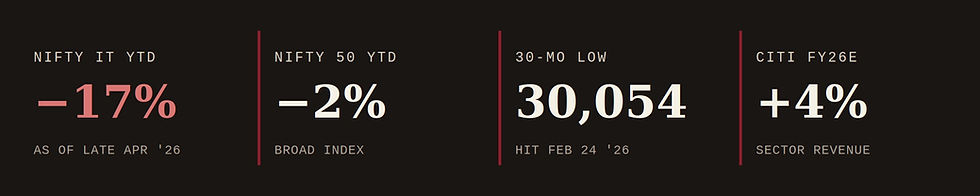
Look at what 2026 has actually done. The KOSPI has doubled. Taiwan's TAIEX is up nearly 30%. Even Japan's Nikkei, a market everyone left for dead a decade ago, is up over 20%. India's Nifty is down about 11% — heading for its first annual decline after a decade of unbroken gains.

That is not a rounding error or a bad quarter. That is a ~110-percentage-point gap between the markets that reformed and the market that hoped.
Korea and Japan didn't get lucky. They got reformed.
Yes, SK Hynix has risen roughly 900% over the past year as high-bandwidth memory became the chokepoint of the AI buildout. That is the headline. But it is not the structural story.
The structural story is that Japan and Korea stopped treating their stock markets as scoreboards and started treating them as institutions to be re-engineered.
In Japan, the Tokyo Stock Exchange did something no Indian regulator has dared: it publicly shamed companies trading below book value into fixing themselves. Firms were ordered to disclose concrete plans to raise return on equity, unwind cross-shareholdings and return cash to shareholders. The share of Prime Market companies trading below 1x book has fallen toward 44% from far higher levels. From March 2025, top-tier firms must disclose in English. The result was not a tech rally — it was a broad rerating of banks, trading houses and industrials, and tens of billions of dollars of foreign inflows chasing it.
Korea launched its Corporate Value-up Program in 2024 to attack the "Korea discount" head-on: phased English disclosure, governance reform, capital-efficiency targets. Here is the detail that should embarrass us most — foreigners actually sold over $70 billion of Korean stock this year, and the market still doubled. The bid came from conviction in the reform and from domestic capital, not from foreigners chasing momentum.
In both countries, markets are not merely repricing earnings. They are repricing institutions. That is the part Mr. Pandey's "concentration" defence misses entirely. And note the irony: the most "concentrated" markets — Taiwan, where TSMC is ~42% of the index, and Korea, where two chipmakers are nearly half — are precisely the ones beating us. Concentration was never India's problem, and diversification was never its shield.
Meanwhile, the money is leaving India — and it is telling us why.
While we reassure ourselves about diversification, foreign investors have pulled roughly $26 billion out of Indian equities in 2026 alone — already more than the entire $18 billion they withdrew across all of 2025, with seven months still to go. March 2026 was the single worst month for FPI outflows on record.

The reasons are not mysterious, and they are not all global:
Valuation: India trades around 21x earnings while Korea offers comparable growth at a fraction of the multiple.
Tax: India has been raising the cost of holding Indian assets — capital gains and securities transaction tax — at the precise moment Singapore and the UAE charge zero. Capital is mobile. It noticed.
Regulatory friction: 197 discussion papers in three years under the previous regime. Flip-flops on FPI disclosure and alternative-fund rules. The market's own participants are begging the regulator to keep it simple.
This is the uncomfortable part. Korea and Japan made their markets easier and more credible to own. India has been making its markets more expensive and less predictable to own. Then we wonder why the savings of the world flow to Seoul and Taipei instead of Mumbai.
The one thing holding the market up is starting to tire.
For three years, there has been a single, reassuring answer to every bout of foreign selling: the domestic SIP investor. Month after month, retail systematic investment plans absorbed whatever the FPIs dumped — a genuinely remarkable structural shift, and the reason Indian equities did not crater through the 2024–25 outflows. The SIP book became the market's shock absorber.
That shock absorber is now showing wear. The SIP stoppage ratio — SIPs discontinued or completed as a share of new registrations — has climbed to roughly 76% in March 2026. To see how far that has moved, the same ratio was around 41% in 2021 and 51% in 2022. Churn has nearly doubled. Monthly SIP contributions have flatlined around the ₹31,000–32,000 crore mark since the start of the year, and net equity inflows have begun edging down month on month.

To be precise: net equity mutual-fund flows are still positive — the streak has held for more than 60 straight months, and the recent headline "outflow" months were driven by seasonal institutional debt redemptions, not equity selling. The domestic bid has not broken. But it is no longer accelerating, and the fastest-rising number in the data is the one that measures investors walking away.
The arithmetic is simple and unforgiving. If foreigners keep selling ~$26 billion a year and the domestic cushion stops thickening, the cushion thins. The market has been propped up by one leg. That leg is tiring — and we have built nothing structural to replace it.
The $4 trillion architecture will not carry us to $40 trillion.
Here is the question every Indian policymaker should be forced to answer: Are our policies making Indian assets more attractive relative to global assets — or less?
Right now the honest answer is less. And the last twelve years of liquidity-driven gains have let us avoid asking it.
India's bottleneck is not Japan's problem — entrenched governance opacity inside ancient conglomerates. India's bottleneck is that it has not built the financial architecture to absorb, compound and recycle capital at scale over the next two decades. We obsess over manufacturing, talent and innovation. But sitting beneath all three is the same constraint: capital markets.
Consider the question everyone asks — why has India, with world-class engineers, not produced a globally dominant frontier AI company? The usual answer blames talent or ecosystem. That answer is wrong. India has the talent. What it lacks is the scale, depth and patience of capital required to finance frontier bets over long horizons.
History is blunt on this point: technological leadership follows financial leadership. The United States did not win successive innovation waves because its founders were uniquely brilliant. It won because it built the deepest, most liquid, most sophisticated capital markets on earth — venture capital, growth equity, public markets and institutional pools that together formed an unmatched financing machine. The talent went where the capital was patient.
So how does it stop? The same way Seoul and Tokyo did it.
India does not need a new idea. It needs to do what its neighbours already did — and the playbook is sitting in plain sight. Four moves, none of them exotic:
1. Tax capital like you want it to stay. Stop raising securities-transaction and capital-gains taxes while Singapore and the UAE sit at zero. The question is not "how much revenue can we extract per trade" but "are Indian assets competitive to own." Right now they are not. Make them so.
2. Run a value-up mandate, Tokyo-style. Force listed companies — and especially the vast bloc of public-sector undertakings trading below book value — to disclose return-on-equity and capital-efficiency plans, unwind dead cross-holdings and return idle cash. India has its own "PSU discount" worth hundreds of billions. Tokyo unlocked exactly this. We have not even named the problem.
3. Unclog the private-market plumbing. Simplify AIF and FPI rules, end the flip-flops, and deliberately build domestic pools of long-duration risk capital — pension and insurance money that can sit in a frontier bet for a decade. This is the capital that finances the AI company everyone keeps asking why India doesn't have.
4. Regulate for capital formation, not friction management. Fewer discussion papers, more stable rules. A regulator whose default question is "does this attract the world's savings into Indian innovation," not "how do we manage the optics of volatility."
None of this is a switch to flip. It is a multi-year build, and it will not move next quarter's index. But that is precisely the point: the countries that win the next several decades will not be the ones that produced the most talent or technology. They will be the ones that built the financial infrastructure to fund both at scale.
Korea reformed. Taiwan concentrated. Both passed us. India did neither — it just hoped. The choice in front of us is not whether the AI wave is "concentrated." It is whether we keep calling our problems diversification, or finally copy the playbook our neighbours have already written.
The pump is over. The reform can begin — if we choose it.
Sources: For the "Why Did India Stock Market Drops To 7th Place - Korea Added $2.3 Trillion. Taiwan Bet It All on Chips. "Data: Bloomberg market-cap data via Business Standard and Outlook Business (Korea/Taiwan vs India crossovers, rankings); Korea Exchange via Seoul Economic Daily and BeInCrypto (KOSPI cap, 2026 performance); TradingKey / Investing.com (SK Hynix); Japan Exchange Group, GMO, DJE Research (TSE reforms); NSDL via Business Standard, Zee Business, Whalesbook (FPI flows, valuations); AMFI monthly data via Business Standard, Republic World and Finnovate (SIP stoppage ratio, equity flows); Business Standard (SEBI regulatory record). All figures as of early June 2026.




Comments